Table of Contents
Enterprise e-commerce is no longer limited to displaying products and processing online payments. Businesses now need digital platforms that connect customer interactions with inventory, pricing, fulfillment, and enterprise operations.
For organizations managing complex product catalogs, multiple markets, or B2B purchasing workflows, disconnected commerce systems can create operational friction.
SAP Commerce Cloud implementation offers a way to bring these capabilities into a connected digital commerce environment.
However, successful implementation requires more than a platform configuration. Businesses must coordinate architecture, data, integrations, customer experience, security, and deployment.
This guide explores how SAP Commerce Cloud works, the essential implementation stages, emerging AI capabilities, and practical considerations for building an adaptable enterprise commerce platform.
What Is SAP Commerce Cloud?
SAP Commerce Cloud is an enterprise digital commerce platform designed to support B2B, B2C, and B2B2C business models.
It enables organizations to manage product information, digital storefronts, pricing, promotions, purchasing journeys, and commerce transactions.
Its value becomes particularly relevant when e-commerce operations must exchange information with ERP, customer management, inventory, and fulfillment systems.
Unlike a standalone online store, SAP Commerce Cloud can become part of a broader enterprise technology architecture.
Organizations can use its established commerce capabilities while extending selected features to accommodate business-specific requirements.
SAP also supports headless and composable storefront approaches, allowing businesses to design customer experiences independently of core commerce services.
Why Businesses Choose SAP Commerce Cloud
Enterprise commerce requirements become more demanding as organizations expand into additional markets, channels, and customer segments.
SAP Commerce Cloud provides capabilities that can address these needs.
- B2B commerce: Support for organizational buyers, customer-specific purchasing processes, and complex pricing.
- Omnichannel operations: Consistent product, promotional, and purchasing experiences across connected channels.
- Enterprise integration: Connections with SAP ERP and third-party business applications.
- Product information management: Centralized catalog information and product content workflows.
- Extensible architecture: APIs and composable storefront options supporting tailored customer journeys.
For example, an industrial distributor may need customers to view negotiated prices, place repeat orders, and obtain accurate inventory information.
A connected commerce architecture can bring these interactions together without requiring customers to navigate separate business systems.
SAP Commerce Cloud Implementation: Step-by-Step Process
A structured implementation approach helps organizations translate commerce requirements into a secure, maintainable application.
Step 1: Define Business Goals and Commerce Requirements
Start by understanding what the platform must accomplish.
Identify target customers, sales channels, purchasing workflows, expected transaction volumes, and integration requirements.
For B2B organizations, account structures, approval processes, negotiated pricing, and bulk ordering may be critical.
B2C businesses may prioritize product discovery, checkout convenience, and personalized engagement.
Define measurable outcomes such as checkout completion, order accuracy, platform availability, and operational efficiency.
Clear requirements help prevent unnecessary customization later.
Step 2: Plan the Technical Architecture
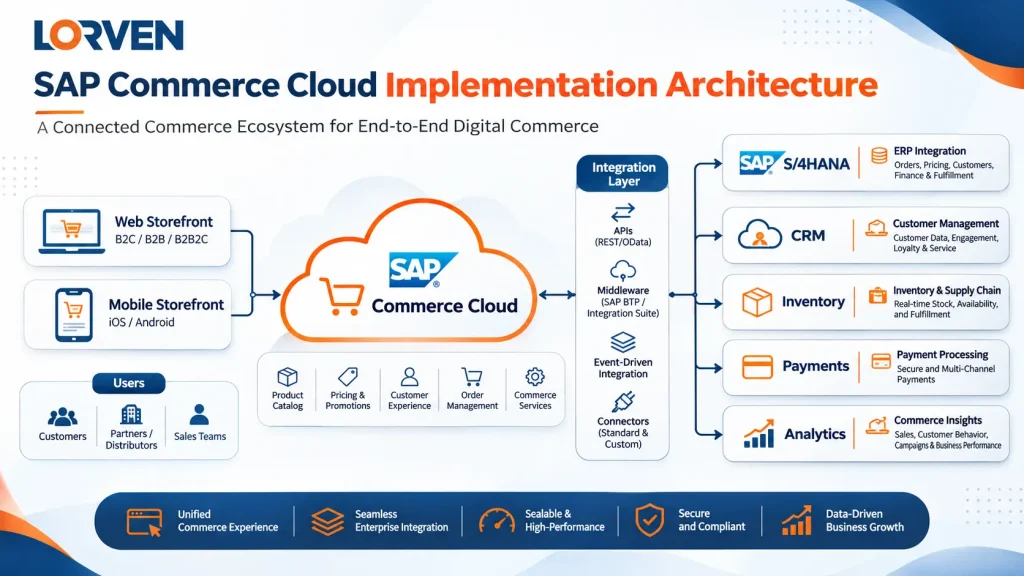
Architecture decisions determine how the commerce platform interacts with the wider enterprise environment.
Businesses should evaluate storefront design, backend extensions, API integrations, security boundaries, and deployment environments.
SAP’s composable storefront uses an Angular-based application that communicates with Commerce Cloud through REST APIs.
This separation allows frontend development to evolve independently from backend commerce functionality.
SAP Help Portal
Organizations should also determine which requirements can be handled through standard platform capabilities and which genuinely need custom engineering.
Step 3: Prepare Product and Customer Data
Data migration is often one of the most demanding implementation activities.
Product catalogs may contain inconsistent descriptions, missing attributes, duplicate records, or different category structures.
Before migration, teams should validate product hierarchies, pricing references, customer accounts, media assets, and relevant historical information.
Data ownership and synchronization rules must also be established.
For instance, ERP may remain the authoritative source for inventory and financial records, while Commerce Cloud manages the customer-facing shopping experience.
Clear ownership prevents conflicting information across systems.
Step 4: Integrate Enterprise Applications
E-commerce becomes more effective when customers see information aligned with actual business operations.
Typical integrations may include:
- SAP S/4HANA or other ERP platforms.
- Customer relationship management systems.
- Payment providers and tax services.
- Warehouse and fulfillment applications.
- Product information and analytics platforms.
SAP Integration Suite and available commerce APIs can support connections between SAP Commerce Cloud and other enterprise applications.
SAP E-Commerce Software
Integration design should consider failure handling, transaction consistency, monitoring, security, and performance under heavy workloads.
Step 5: Develop and Customize the Storefront
The customer-facing experience should reflect how different users discover products, evaluate options, and complete purchases.
Development may include responsive interfaces, custom account dashboards, product navigation, checkout workflows, and accessibility improvements.
B2B storefronts may require purchase approvals, account-specific catalogs, or repeat-order functionality.
A composable approach allows teams to build differentiated interfaces while retaining established commerce services.
Customization should remain purposeful. Excessive changes to core functionality can increase maintenance requirements and complicate upgrades.
Step 6: Test Security, Performance and Business Workflows
Testing should cover the complete purchasing journey rather than isolated application components.
Important areas include account authentication, catalog accuracy, pricing calculations, payment integrations, checkout, and order confirmation.
Performance testing should simulate anticipated traffic and transaction conditions.
Security validation should review access controls, sensitive information handling, API authorization, and application vulnerabilities.
Business users should also participate in acceptance testing to confirm that actual purchasing and fulfillment processes function correctly.
Step 7: Deploy and Optimize
SAP Commerce Cloud provides a Cloud Portal for managing environments, builds, deployments, and operational activities.
SAP Help Portal
Before launching, teams should verify integrations, production configuration, monitoring, backup procedures, and rollback plans.
Following deployment, measure business and technical performance.
Monitor checkout abandonment, order failures, response times, search effectiveness, and customer feedback.
Continuous improvement should be guided by observed customer behavior and measurable commercial outcomes.
Latest SAP Commerce Cloud Capabilities in 2026
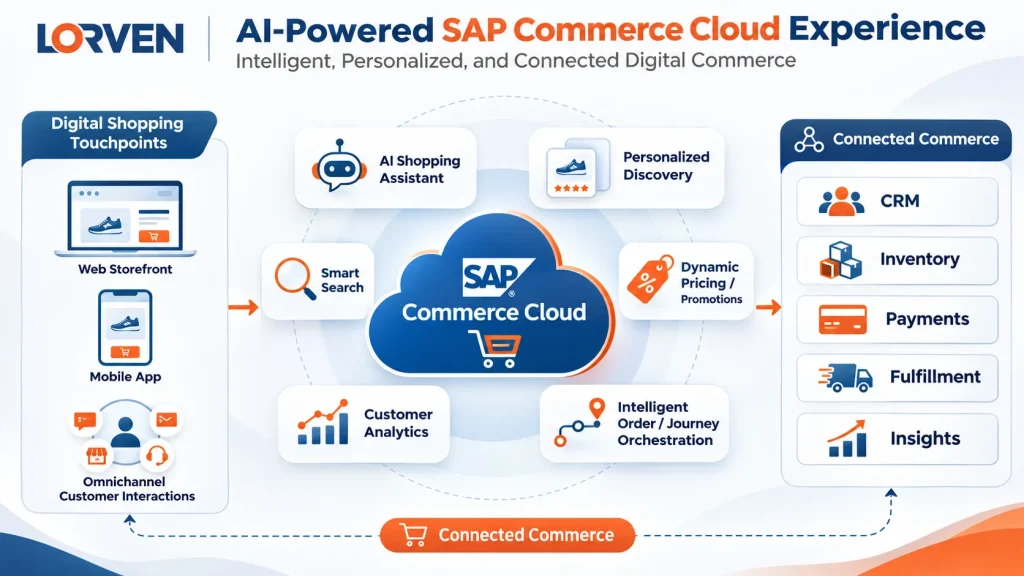
SAP’s current product information highlights AI-enabled selling, unified product data, composable storefronts, and connected commerce operations.
Recent capabilities described by SAP include conversational shopping assistance, intelligent product recommendations, AI-enhanced commerce search, and model context protocol (MCP) connectivity for AI agents
These developments are relevant to businesses exploring more intelligent customer experiences.
For example, an AI shopping assistant can help customers compare products through natural-language interactions, while relevant enterprise information can support more context-aware purchasing guidance.
However, organizations should evaluate feature availability, licensing, regional support, and technical prerequisites before including these capabilities in an implementation of roadmap.
AI adoption should solve defined customer or operational problems rather than introduce unnecessary complexity.
Common SAP Commerce Cloud Implementation Challenges
Implementation complexity typically comes from business-specific requirements rather than storefront development alone.
Common challenges include inconsistent product data, legacy application dependencies, complex B2B pricing, integration failures, and performance bottlenecks.
Organizations may also underestimate customization maintenance, migration testing, and the internal resources required for change management.
An effective strategy is to prioritize essential workflows, maintain clear data ownership, use standard capabilities where practical, and introduce enhancements through controlled releases.
How Lorven Technologies Supports Enterprise Commerce Modernization
Lorven Technologies focus on software development, SAP and enterprise applications, cloud engineering, data analytics, and digital transformation aligns with the technical requirements of connected commerce initiatives.
Enterprise modernization requires coordination between application architecture, backend integration, secure engineering, and business processes.
A well-planned approach helps organizations build adaptable commerce experiences while supporting the reliability of existing enterprise systems.
SAP Commerce Cloud Implementation Cost
The cost of SAP Commerce Cloud implementation depends on integration complexity, customization, infrastructure, and ongoing maintenance. Businesses can better plan their technology investments by understanding SAP ERP implementation costs, evaluating the cost of cloud storage for business, comparing multi-cloud vs. hybrid cloud architectures, and exploring how to implement AI in business to enhance digital commerce experiences.
Conclusion
Successful SAP Commerce Cloud implementation requires a clear strategy connecting customer experience, enterprise data, integration architecture, and operational performance.
Businesses should approach implementation as an ongoing technology investment rather than a one-time website launch.
By combining thoughtful architecture, secure engineering, and continuous improvement, organizations can establish a stronger foundation for digital commerce.
Explore our SAP and digital transformation capabilities to support your enterprise commerce modernization strategy.