Companies are using it to automate processes, understand data, support employees, and improve customer experiences. But implementing AI is not as simple as adding a new tool to your technology stack. The real challenge is deciding where AI can create value, how it should fit into existing systems, and how to scale it safely. We explained how to implement AI in business through a practical approach from identifying the right opportunity and preparing your organization to test, integrating, governing, and scaling AI solutions.
What Does AI Implementation in Business Actually Mean?
AI implementation means putting artificial intelligence to work on real business needs. This could mean automating a manual process, helping teams analyze information, improving customer interactions, or supporting faster decisions.
AI adoption should be guided by business priorities. Focus on investment in areas where intelligent technology can solve a genuine problem or create measurable improvement… It is to find the areas where AI can solve a meaningful problem and fit naturally into the way your organization already works.
For example, a company might use AI to summarize large volumes of documents, predict demand, assist customer service teams, detect unusual transactions, or help employees find information faster.
In simple terms, successful AI implementation connects the right business problem with the right AI solution supported by reliable data, suitable technology, and clear human oversight.
Where Can Businesses Apply AI?
AI can be useful across almost every part of an organization, but the best opportunities are usually found in processes that involve large amounts of data, repetitive work, or complex decision-making.
Common areas include:
- Customer Experience: Assist with customer queries, personalization, and service operations.
- Finance: Support fraud detection, financial analysis, and forecasting.
- Sales: Analyze customer behavior, improve lead qualification, and support sales teams.
- Operations: Automate workflows, optimize processes, and improve resource planning.
- Human Resources: Support workforce insights, employee learning, and internal services.
- IT: Assist with monitoring, service management, software development, and cybersecurity.
- Management: Turn business data into insights that support planning and decision-making.
The right starting point depends on the organization’s goals. Instead of trying to apply AI everywhere, businesses should focus first on areas where the potential value is clear and measurable.
How to Build an AI Implementation Strategy ?
Before choosing an AI, platform or starting a project, organizations need a clear direction. An AI implementation strategy connects technology decisions with business priorities.
A practical strategy should answer four questions:
- What problem are we trying to solve?
- Where can AI create the most value?
- What data and technology do we need?
- How will we measure the results?
Start by defining a business goal, such as reducing processing time, improving customer service, or increasing operational efficiency. Then identify the AI capabilities needed to support that goal.
The strategy should also consider budget, data readiness, security, employee adoption, and long-term scalability. This helps organizations avoid disconnected AI experiments and build a clear path from the first project to wider adoption.
A Practical 7-Phase AI Implementation Framework
Once the business goal is clear, the next step is to turn the strategy into action. A structured implementation process helps organizations reduce risk, test ideas quickly, and build AI solutions that can grow with the business.
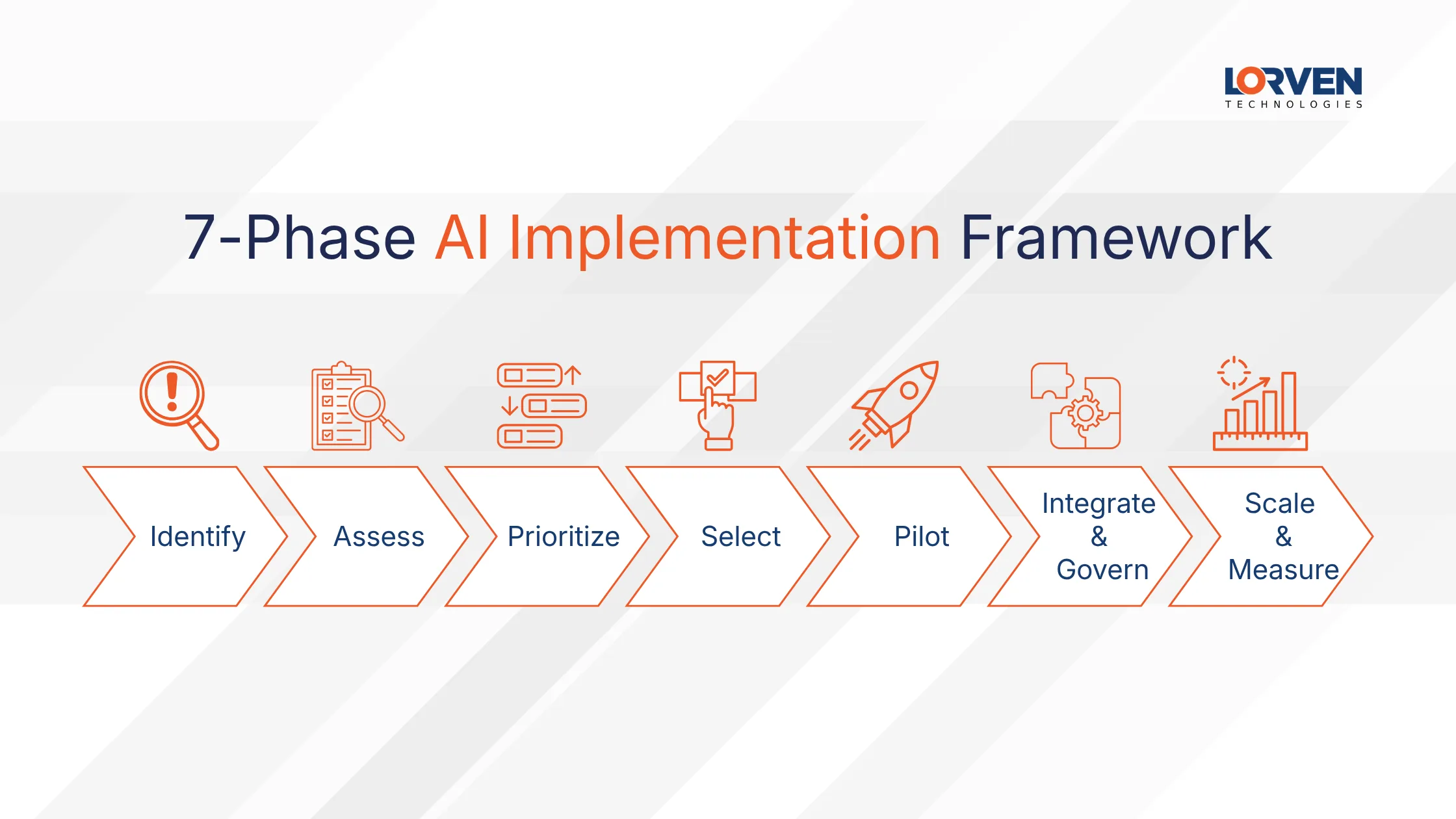
Phase 1: Identify the Business Opportunity
Start with the business challenge, not technology. Look for processes where AI could reduce effort, improve accuracy, speed up decisions, or create a better customer experience.
Define the problem clearly and set a measurable outcome. This gives the project a clear direction from the beginning.
Phase 2: Evaluate Data and AI Readiness
AI is only as effective as the foundation supporting it. Before moving forward, assess whether your organization has the data, technology, skills, and infrastructure needed for the project.
Review key areas such as:
- Data: Is the required data available, accurate, and secure?
- Technology: Can your existing systems support AI integration?
- Infrastructure: Do you have the right cloud and computing environment?
- People and Expertise: Identify whether your organization has the technical and operational expertise required to deploy, maintain, and improve the AI solution.
- Security: Can sensitive data and AI systems be protected?
This assessment helps identify gaps early and gives your team a clearer understanding of what needs to be improved before implementation begins.
Phase 3: Prioritize the Right AI Use Cases
Not every AI opportunity deserves immediate investment. Once you understand your business needs and readiness, compare potential use cases and focus on the ones that offer the strongest value.
Consider:
- Business Impact: Can it reduce costs, save time, increase revenue, or improve customer experience?
- Feasibility: Can your organization realistically implement it with available technology and skills?
- Data Availability: Do you have enough reliable data to support the solution?
- Risk: Could the use case create security, privacy, compliance, or operational concerns?
Start with use cases that have clear business value and manageable complexity. A focused approach makes it easier to prove results and build confidence for future AI initiatives.
Phase 4: Select the Right AI Approach
Once you have identified a high-value use case, decide how the solution should be built or adopted. The right approach depends on your business requirements, data, budget, security needs, and level of customization.
You may choose from:
- Ready-to-use AI tools for common business needs
- AI APIs and platforms to add AI capabilities to existing applications
- Custom AI solutions for specialized business requirements
- Generative AI and LLMs for content, knowledge, and productivity use cases
- AI agents for tasks that require multiple steps or interaction with business systems
The key decision is whether to buy, build, or customize. Choose the approach that delivers the required business value while remaining secure, scalable, and practical to maintain.
Phase 5: Run a Controlled Pilot
Before rolling out AI across the organization, test the solution on a limited scale. A pilot helps you understand how well the AI works in a real business environment and what changes may be needed.
Start by:
- Defining a clear scope and timeline
- Selecting a small group of users
- Setting measurable success criteria
- Testing the solution with real business scenarios
- Collecting user feedback
- Reviewing performance and results
Use the pilot to identify gaps, improve the solution, and confirm whether it delivers the expected business value. If the results are positive, the organization can move forward with greater confidence.
Phase 6: Integrate and Govern AI
Once the pilot proves its value, integrate the AI solution into your existing business processes and technology environment. The goal is to make AI a useful part of everyday operations rather than a standalone experiment.
At the same time, establish clear governance to manage risks and maintain trust.
Focus on:
- Connecting AI with existing business applications and workflows
- Protecting sensitive data and controlling access
- Monitoring AI performance and accuracy
- Defining clear rules for responsible AI use
- Maintaining human oversight where needed
- Meeting security, privacy, and compliance requirements
Strong integration and governance help organizations use AI safely while creating a reliable foundation for long-term adoption.
Phase 7: Scale and Measure
Once an AI solution has been tested, integrated, and governed, the next step is to expand it across the organization. Scaling should be based on proven results rather than assumptions.
Track key metrics such as:
- Cost savings
- Time saved
- Productivity improvements
- Customer satisfaction
- Revenue impact
- User adoption
- Accuracy and reliability
Use these results to decide where AI should be expanded, improved, or redesigned. As the business grows, continue reviewing the technology, data, security, and user experience.
The goal is to move from a successful AI project to a sustainable capability that delivers measurable value across the organization.
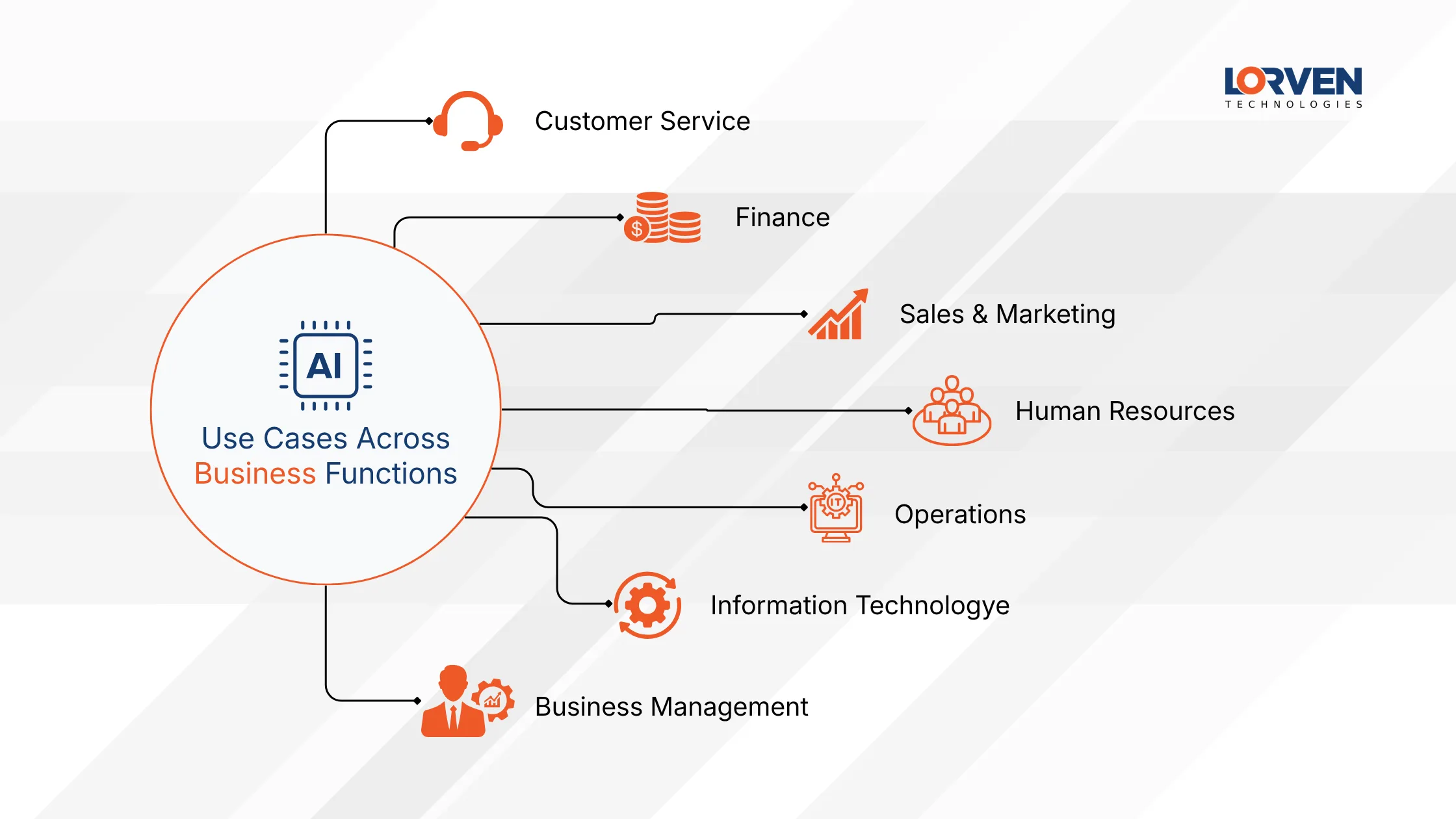
AI Use Cases Across Business Functions
AI can support different teams and processes depending on an organization’s needs. The most effective use cases are those that solve a clear problem and deliver measurable results.
- Customer Service
AI-powered assistants can help answer common questions, summarize customer interactions, and support service teams. - Finance
AI can assist with fraud detection, financial analysis, forecasting, and processing large volumes of transactions. - Sales and Marketing
AI can help teams understand customer behavior, identify opportunities, personalize experiences, and improve sales forecasting. - Human Resources
AI can support employee services, workforce analytics, learning, and internal knowledge management. - Operations
AI can improve workflows, automate repetitive tasks, optimize resources, and support demand planning. - IT and Software Development
AI can assist with code development, system monitoring, incident management, cybersecurity, and IT service operations. - Business Management
AI can help leaders analyze information, identify trends, and make faster, data-informed decisions.
The best approach is to start with one or two high-impact use cases, measure the results, and expand AI adoption based on what works.
Benefits and Challenges of Implementing AI in Business
AI can create significant value, but successful adoption requires organizations to balance opportunity with practical challenges.
Key Benefits
- Higher Productivity: Automating repetitive work gives employees more time for strategic tasks.
- Better Decisions: AI can analyze large volumes of information and surface useful patterns.
- Faster Operations: Intelligent workflows can reduce processing time and improve efficiency.
- Improved Customer Experience: AI can support faster, more personalized interactions.
- Business Agility: AI can help organizations respond more quickly to changing customer and market needs.
Common Challenges
- Data Readiness: Incomplete or poor-quality data can limit AI performance.
- Integration: Connecting AI with existing applications and workflows may require significant effort.
- Security and Privacy: Sensitive information must be protected throughout the AI lifecycle.
- Skills Gap: Teams may need new technical and business skills to adopt AI effectively.
- Change Management: Employees need the right training and support to work confidently with AI.
- AI Governance: Establish practical controls for data protection, model oversight, accountability, and regulatory requirements throughout the AI lifecycle.
AI delivers the greatest value when technology, people, processes, and governance are planned together.
How to Measure AI Success and Business Impact?
Launching an AI solution is not the final step. Organizations need to measure its performance and business impact to understand whether the investment is delivering the expected results.
Useful metrics can include:
- Cost Savings: How much does the solution reduce operational costs?
- Time Savings: How much manual effort or processing time has been reduced?
- Productivity: Are employees completing tasks faster or handling more work?
- Customer Experience: Has satisfaction improved or response time decreased?
- Revenue: Has AI contributed to new revenue or improved sales performance?
- Accuracy: Is the AI solution producing reliable and consistent results?
- Adoption: Are employees and customers actively using the solution?
- ROI: Is the value generated by AI greater than the investment required?
The right metrics will vary by use case. A customer service AI project may focus on response time and satisfaction, while an operations project may focus on cost, productivity, and processing speed.
Regular measurement helps organizations understand what is working, identify gaps, and make informed decisions about future AI investments.
AI Use Cases Across Industries
AI adoption looks different across industries because each sector has its own processes, data, and challenges. The best results come from applying AI to specific business needs rather than using a one-size-fits-all approach.
- Banking & Financial Services: AI can help financial organizations identify unusual transaction patterns, strengthen risk analysis, automate routine service interactions, and improve financial planning.
- Healthcare: Medical data analysis, administrative automation, patient support, and research assistance.
- Manufacturing: Predictive maintenance, quality inspection, production optimization, and supply chain planning.
- Retail & E-commerce: Product recommendations, demand forecasting, inventory management, and customer engagement.
- Telecommunications: Network monitoring, service optimization, customer support, and churn prediction.
- Energy & Utilities: Asset monitoring, predictive maintenance, energy forecasting, and resource optimization.
- Government: Citizen services, document processing, workflow automation, and data analysis.
The right AI solution depends on the industry’s goals, available data, regulatory environment, and technology landscape. Organizations should begin with use cases where the business impact can be clearly measured.
The Future of AI in Business
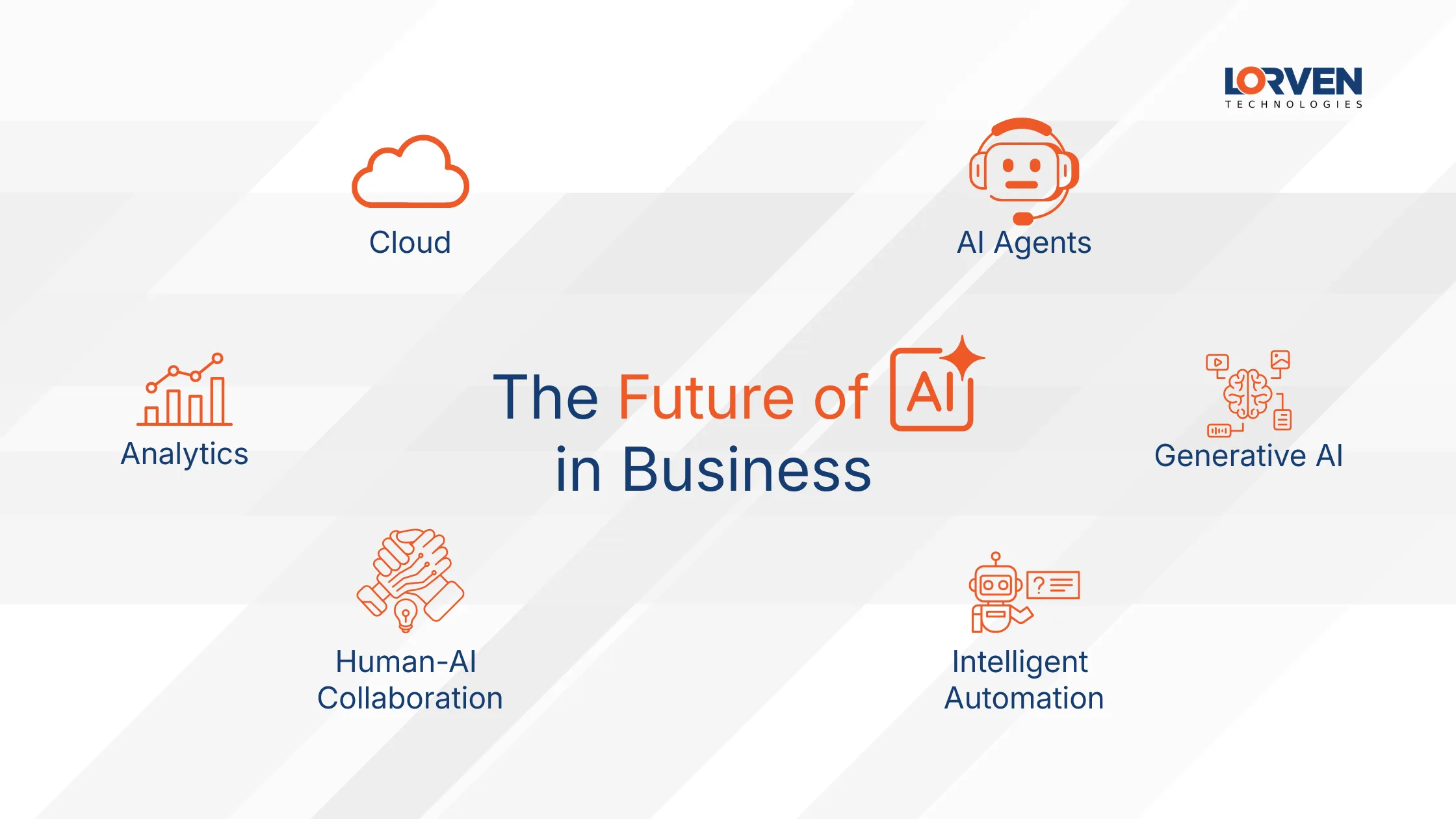
AI is moving beyond individual tools and isolated projects. As technology matures, organizations are beginning to build AI into their products, platforms, workflows, and decision-making processes.
Several developments are likely to shape the next phase of business AI:
- Generative AI: Helping teams create content, analyze information, write code, and access organizational knowledge.
- AI Agents: Handling multi-step tasks and working with business systems to complete workflows.
- Intelligent Automation: Combining AI with automation to manage processes that previously required significant manual effort.
- AI-Powered Analytics: Turning large and complex datasets into insights that support faster decisions.
- AI-Native Applications: Building software with AI capabilities at the core rather than adding them later.
- Human-AI Collaboration: Combining machine speed and analysis with human judgment, creativity, and expertise.
For businesses, the next challenge will not simply be adopting AI. It will be building the right foundation to use it responsibly and at scale.
Organizations that align AI strategy, data, cloud infrastructure, cybersecurity, software development, and people will be better positioned to turn AI investment into long-term business value.
Conclusion
AI implementation is not a one-time technology project. It is a continuous journey that starts with a clear business need and grows through testing, learning, and improvement.
The right approach is to begin with a focused use case, prepare the right data and technology foundation, test the solution in a controlled environment, and measure its real-world impact. As the results become clear, organizations can expand AI across teams and business functions.
With the right strategy, governance, and technology ecosystem, AI can help businesses improve productivity, make better decisions, streamline operations, and create new opportunities for growth.
Ready to Implement AI for Your Business?
We work with organizations to turn emerging AI capabilities into practical technology solutions. Our expertise spans AI and Generative AI, cloud, ddata, software engineering, cybersecurity, and digital transformation, helping businesses address complex technology needs and move from ideas to implementation.
Talk to the Lorven Technologies team about building an AI strategy that fits your business goals.