Technology has become central to how modern businesses operate. From cloud applications and digital workplaces to cybersecurity and data platforms, organizations increasingly depend on reliable and secure IT environments to keep their operations running.
At the same time, managing technology has become more complex.
Businesses must maintain infrastructure, support employees, secure systems, manage cloud environments, respond to cyber threats, and meet regulatory requirements. For many organizations, building and maintaining all these capabilities internally can be challenging.
An MSP gives organizations another way to handle this complexity: combining ongoing IT management with access to specialized expertise without building every capability in-house.
What Is a Managed Service Provider?
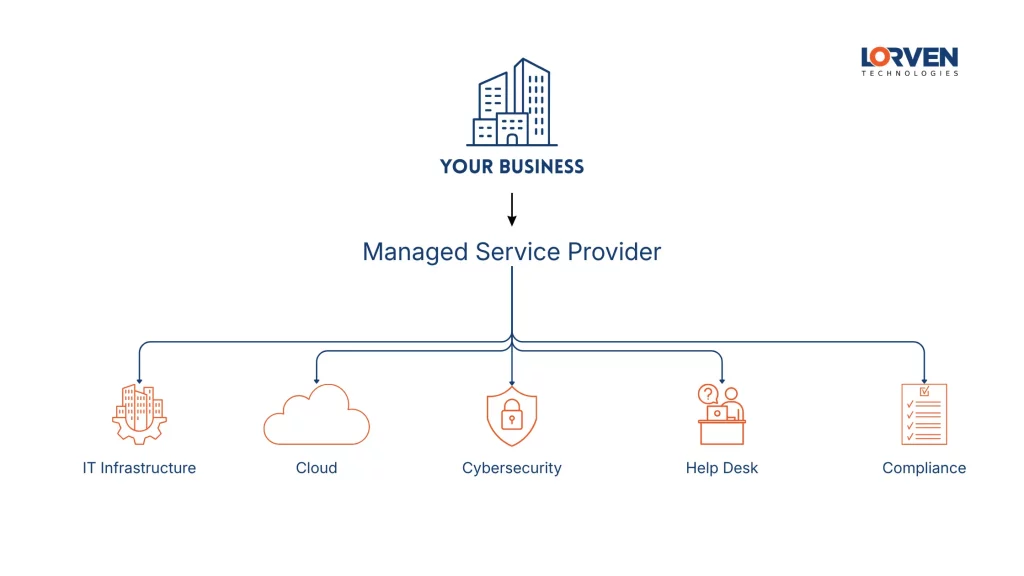
A Managed Service Provider is a third-party technology partner that manages specific IT services or technology operations on behalf of an organization.
Depending on business requirements, an MSP may provide Managed IT Services, infrastructure management, cloud operations, cybersecurity, help desk support, backup and disaster recovery, or compliance assistance.
Unlike the traditional break-fix model, where IT teams respond after a problem occurs, modern MSPs typically take a proactive approach. They monitor systems, identify potential issues, maintain technology environments, and help organizations improve IT operations over time.
For example, instead of waiting for a server to fail, an MSP can continuously monitor its performance and identify warning signs before the failure affects employees or customers.
This shift from reactive support to proactive management is one of the biggest changes in the MSP industry.
Why Are MSPs Growing?
The growth of MSP services is closely connected to the changing technology landscape.
Cloud adoption has expanded. Cybersecurity threats have become more sophisticated. Hybrid work has created new IT management requirements. Organizations are also exploring AI, automation, and data-driven technologies while continuing to operate legacy systems.
As a result, businesses need access to a wider range of technology expertise.
A mid-sized company, for example, may need cloud engineers, cybersecurity specialists, infrastructure experts, and service desk professionals. Hiring and retaining dedicated teams for every capability may not always be practical.
An MSP can provide access to specialized skills and operational support without requiring the organization to build every capability internally.
However, modern MSPs are increasingly expected to deliver more than technical support.
Organizations now look for technology partners that can help improve efficiency, strengthen security, optimize IT spending, and support broader digital transformation objectives.
This has changed the role of the MSP from an outsourced support provider into a potential Managed Services Partner.
How MSPs Work?
The MSP model is based on an ongoing relationship between the service provider and the organization.
Rather than engaging a provider only when something goes wrong, a business typically defines the services it wants the MSP to manage and establishes clear responsibilities, service levels, and performance expectations.
Service Model
An MSP service model can be customized based on the organization’s requirements.
Some businesses may outsource their entire IT operations, while others may use an MSP for specific functions such as cloud management, cybersecurity, infrastructure monitoring, or help desk services.
A hybrid model is also common.
For example, an organization’s internal IT team may focus on business applications and technology strategy, while an MSP manages infrastructure monitoring, employee support, and cloud operations.
This approach allows organizations to combine internal business knowledge with external technical expertise.
SLA Structure
A Service Level Agreement, or SLA, defines the expected level of service between the organization and the MSP.
An SLA may include:
- Service availability
- First-response time
- Incident resolution targets
- Support hours
- Escalation procedures
- System monitoring requirements
- Reporting expectations
A strong SLA should reflect the business impact of different IT issues.
For example, a critical production system outage may require immediate response, while a low-priority user request may have a longer resolution target.
A 15-minute response time has little value if the provider cannot restore a business-critical application quickly. When reviewing an SLA, look at what happens during a real outage not just the number attached to the initial response.
Support Lifecycle
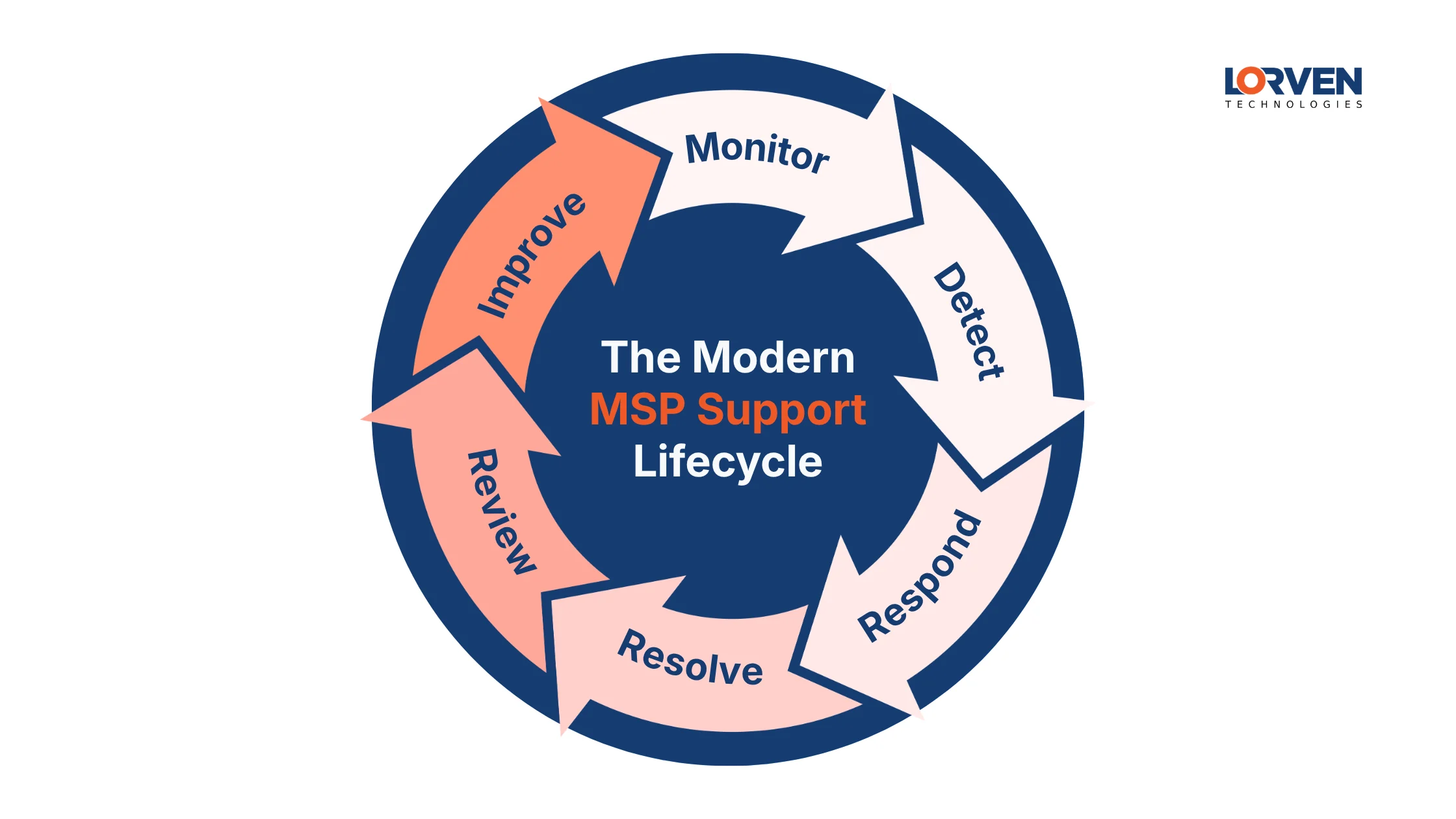
Modern MSP operations generally follow a continuous lifecycle:
Monitor → Detect → Respond → Resolve → Review → Improve
The process begins with proactive monitoring of technology environments.
When an issue is detected, the MSP investigates and responds according to the agreed service level. After resolution, the provider can analyze the incident to identify recurring problems and opportunities for improvement.
After resolving an incident, the MSP should examine what caused it and take steps to prevent the same problem from affecting operations again.
This proactive approach can help organizations move from reactive IT management toward more predictable and efficient operations.
Core MSP Services
Modern MSPs can provide a broad range of services depending on the organization’s technology environment.
IT Infrastructure Management
IT Infrastructure Management involves monitoring and maintaining essential technology systems such as servers, networks, storage, virtualization platforms, and operating environments.
Proactive infrastructure monitoring can help identify performance issues, capacity constraints, and potential failures before they significantly affect business operations.
For businesses with complex or distributed environments, this can provide greater visibility and operational stability.
Cloud Services
Cloud adoption has changed the MSP’s role. Instead of simply maintaining physical infrastructure, providers increasingly help organizations operate, secure, govern, and optimize workloads spread across on-premises and cloud environments.
Cloud Managed Services may include cloud migration, infrastructure management, monitoring, security, governance, and cost optimization.
An MSP can help organizations manage hybrid environments that combine on-premises infrastructure with public and private cloud platforms.
The objective should not simply be to move everything to the cloud. Instead, businesses need to determine where each workload can operate most effectively based on performance, security, scalability, and cost.
Cybersecurity Services
Security is now a fundamental part of IT management.
Modern MSPs may provide cybersecurity capabilities such as endpoint protection, vulnerability management, security monitoring, identity management, and threat detection.
Some providers also offer managed security services to help organizations strengthen their security posture and respond to emerging threats.
For businesses without extensive internal cybersecurity expertise, an MSP can provide access to specialized capabilities that may otherwise be difficult to maintain.
Help Desk and End-User Support
Help desk services provide employees with support for common technology issues, including application problems, device issues, access requests, and password-related incidents.
A structured service desk can improve employee productivity by helping users resolve issues quickly and consistently.
It can also reduce the operational burden on internal IT teams, allowing them to focus on more strategic technology priorities.
Compliance and Governance Support
Organizations operating in regulated industries often need to maintain appropriate technology controls, documentation, access management, and security processes.
MSPs can support these efforts by helping manage technical controls, monitoring environments, maintaining documentation, and providing reporting capabilities.
However, businesses should clearly define responsibilities. An MSP can support compliance requirements, but accountability for regulatory compliance ultimately remains with the organization.
Conclusion
The role of the Managed Service Provider has evolved significantly.
Modern MSPs are no longer limited to fixing technical problems after they occur. They can help organizations proactively manage infrastructure, operate cloud environments, strengthen security, support employees, and maintain technology governance.
The right MSP model can also provide organizations with access to specialized expertise without requiring them to build every technical capability internally.
However, the value of managed services depends on choosing the right approach and the right partner.
Businesses should first understand their technology requirements, identify the areas where internal capabilities may be limited, and determine which services would benefit from external expertise.
As IT environments continue to evolve through cloud adoption, cybersecurity, automation, and AI, organizations need technology operations that can adapt with them.
For businesses exploring a more structured approach to IT management, evaluating your current technology environment is a practical first step. Understanding where you need greater expertise, scalability, or operational support can help you determine whether a managed services approach is right for your organization.
With experience across IT services, cloud, cybersecurity, AI, enterprise technologies, and digital transformation, Lorven Technologies can be part of that conversation helping organizations explore technology approaches aligned with their operational needs and long-term business objectives.