Technology has become central to how enterprises operate, compete, and grow. Yet managing increasingly complex infrastructure, cloud environments, cybersecurity risks, applications, and emerging technologies internally can place significant pressure on IT teams. This is where the benefits of managed services models become increasingly relevant. More than outsourced technical support, modern managed services provide organizations with continuous expertise, proactive operations, and scalable technology management. The benefits of managed services extend from reducing downtime and controlling costs to strengthening security and accelerating digital transformation.
For IT leaders, the question is no longer simply who will resolve the next IT issue. It is how technology operations can become more resilient, secure, intelligent, and aligned with business objectives.
Top Benefits of Managed Services Model
The benefits of managed services models are particularly valuable for enterprises dealing with hybrid infrastructure, cybersecurity pressures, cloud adoption, application complexity, and the need to modernize at speed.
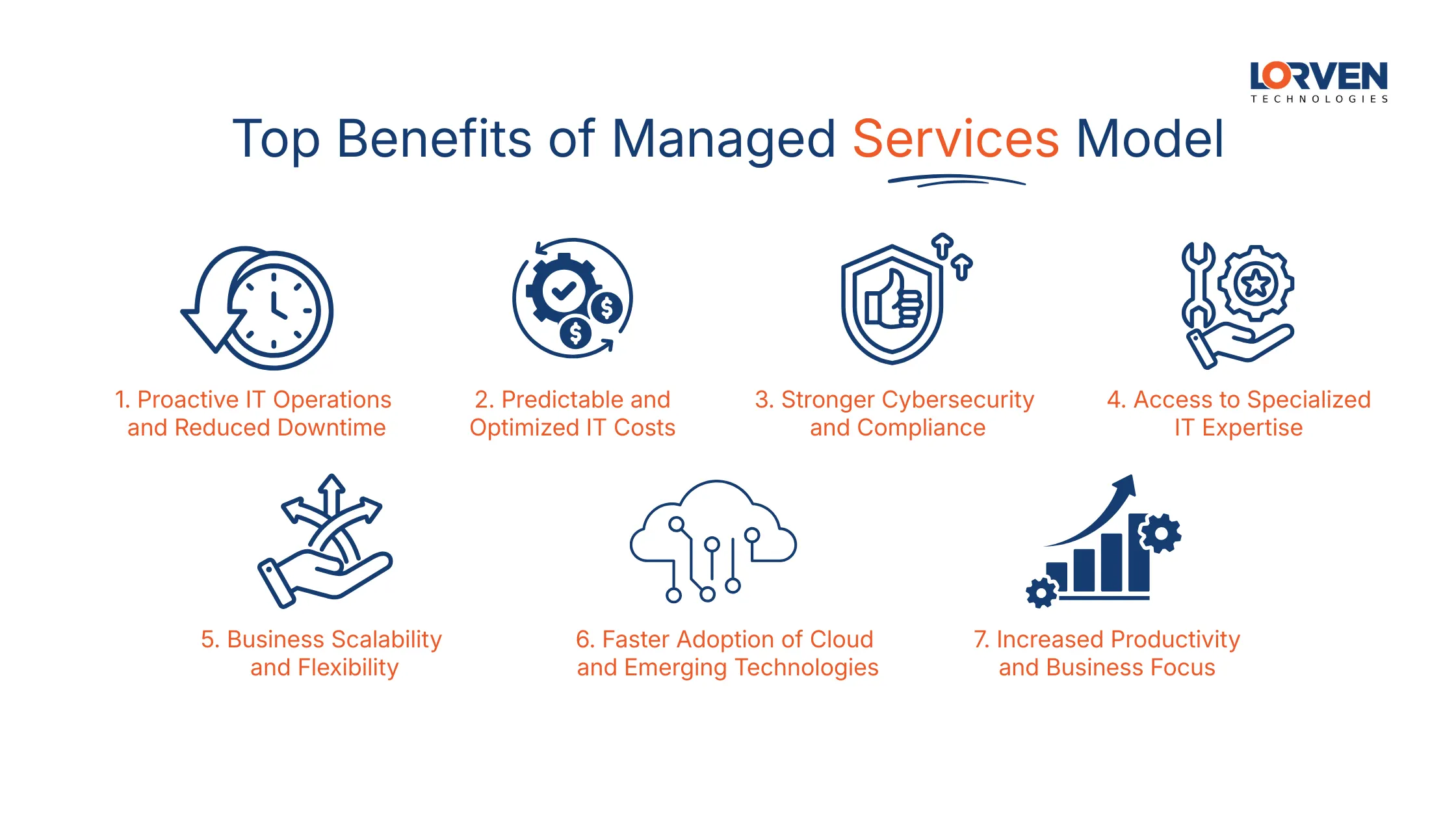
1. Proactive IT Operations and Reduced Downtime
Unexpected technology disruptions can affect productivity, customer experience, revenue, and operational continuity.
Managed services introduce continuous monitoring and preventive maintenance across critical environments. Instead of waiting for infrastructure or applications to fail, service teams can identify unusual activity, performance degradation, capacity constraints, or recurring issues earlier.
This enables:
- 24/7 monitoring of critical environments
- Preventive maintenance and performance optimization
- Faster identification and resolution of incidents
- Better infrastructure reliability
- Reduced operational disruption
For enterprise IT leaders, proactive management changes the conversation from “How quickly can we fix it?” to “How can we prevent it?”
2. Predictable and Optimized IT Costs
Technology costs can become difficult to forecast when organizations depend heavily on reactive support, emergency projects, and expanding internal teams.
Managed services commonly use predictable, subscription-based engagement models that make technology spending easier to plan. Organizations can align service costs with business requirements while reducing some of the operational overhead associated with maintaining every specialized capability internally.
The value is not simply lower in cost. It is greater cost visibility and better allocation of IT resources.
3. Stronger Cybersecurity and Compliance
Cybersecurity cannot remain a periodic activity. Modern enterprises require continuous visibility across infrastructure, endpoints, applications, identities, and cloud environments.
Managed cybersecurity services can combine threat monitoring, vulnerability management, security operations, and compliance support to create a more consistent security posture.
Key advantages include:
- Continuous threat monitoring
- Vulnerability identification and remediation
- Security event management
- Compliance readiness
- Structured security operations
For organizations operating in regulated industries, managed security capabilities can also help technology teams establish more consistent controls and processes.
4. Access to Specialized IT Expertise
Enterprise technology environments increasingly require expertise across multiple disciplines. A single internal team may not have deep specialists in cloud architecture, cybersecurity, infrastructure engineering, enterprise applications, automation, and emerging technologies simultaneously.
Working with experienced managed services providers can give organizations access to specialized capabilities when and where they are needed.
This may include:
- Cloud and infrastructure specialists
- Cybersecurity professionals
- Enterprise application experts
- DevOps and automation capabilities
- Technology modernization expertise
This model enables enterprises to supplement internal capabilities without making every technology requirement dependent on permanent internal hiring.
5. Business Scalability and Flexibility
Technology requirements change as businesses enter new markets, launch products, expand operations, or establish new digital capabilities.
Managed services provide flexibility to scale resources and services according to changing requirements. New users, workloads, applications, cloud resources, or operational requirements can be incorporated without redesigning the entire IT operating model.
For growing organizations, this flexibility can support:
- Faster onboarding
- Infrastructure expansion
- Resource scaling
- New technology deployments
- Changing operational requirements
Scalability therefore becomes an operational capability rather than a recurring IT bottleneck.
6. Faster Adoption of Cloud and Emerging Technologies
Cloud adoption, AI, automation, and application modernization are increasingly interconnected with enterprise transformation.
Cloud managed services can help organizations optimize cloud environments, improve operational visibility, manage workloads, and align cloud resources with business requirements.
The same principle applies to AI initiatives. AI-powered managed services can introduce intelligent monitoring, automation, predictive analysis, and more efficient operational workflows.
Rather than treating emerging technology as isolated experiments, managed services can help integrate these capabilities into an organization’s broader technology strategy.
7. Increased Productivity and Business Focus
Every hour IT teams spend dealing with repetitive incidents, infrastructure administration, or routine monitoring is time that cannot be spent on strategic initiatives.
Managed support services can absorb recurring operational responsibilities, allowing internal teams to focus more heavily on innovation, modernization, architecture, and business priorities.
This can contribute to:
- Lower administrative burden
- Better employee technology experiences
- Faster issue resolution
- More time for strategic IT initiatives
- Stronger alignment between IT and business objectives
The greatest productivity benefit may therefore come from what internal teams are able to focus on instead of what they no longer have to manage.
The Evolution of Managed Services: From IT Support to Business Outcomes
The managed services market is moving beyond traditional infrastructure monitoring and helping desk operations.
Modern service models increasingly combine automation, AI-powered operations, predictive monitoring, cloud engineering, cybersecurity, and data-driven decision-making.
This evolution matters because enterprises are no longer interested in measuring success solely through the number of tickets closed.
They increasingly want measurable outcomes such as:
- Improved system availability
- Stronger security posture
- Optimized cloud performance
- Faster operational processes
- Reduced technology friction
- Greater automation
- Accelerated modernization
AI and automation are particularly important to this evolution. Predictive monitoring can help identify potential operational issues, while intelligent automation can reduce repetitive tasks and accelerate response processes.
The strategic role of a service partner is therefore changing—from support provider to technology outcomes partner.
Why Businesses Choose Lorven Technologies for Managed Services?
Lorven Technologies approaches managed services through a broader enterprise technology and digital transformation perspective. Its capabilities span managed IT services, cloud services, cybersecurity, enterprise solutions, Generative AI, and digital transformation.
Rather than treating managed services as isolated IT support, the approach can be viewed through five connected stages:
Manage → Secure → Optimize → Automate → Transform
Manage
Proactively manage infrastructure, cloud environments, applications, and IT operations to improve reliability and operational continuity.
Secure
Strengthen technology environments through cybersecurity, risk management, compliance, threat detection, and security-focused operations.
Optimize
Improve cloud utilization, application performance, infrastructure efficiency, and technology processes to create greater operational value.
Automate
Use automation and AI-driven capabilities to reduce repetitive work, improve operational efficiency, and create more intelligent workflows.
Transform
Connect technology modernization with broader digital transformation objectives, helping enterprises evolve their applications, processes, and technology operating models.
This approach aligns with Lorven Technologies’ positioning as a software development and digital transformation company focused on AI, cloud engineering, enterprise applications, cybersecurity, data analytics, and modernization.
For enterprise organizations, that broader capability can be particularly valuable when managed operations are part of a larger transformation roadmap rather than an isolated outsourcing decision.
Conclusion
The benefits of managed services models go far beyond reducing the burden of IT support. They include proactive IT operations, predictable costs, stronger cybersecurity, access to specialized expertise, scalable resources, faster technology adoption, and greater organizational productivity.
More importantly, managed services are evolving from a reactive support function into a strategic technology operating model. AI, cloud, cybersecurity, automation, and digital transformation are increasingly becoming part of the same enterprise technology conversation.
For modern businesses, the objective should not simply be to outsource IT tasks. It should be to build a technology environment that is more resilient, secure, optimized, intelligent, and ready for change.
That is where the real benefits of managed services emerge and where managed services can become a competitive advantage rather than simply an operational expense.
Ready to Move Beyond Traditional IT Support?
Our managed services that can help your organization reduce risk, improve performance, and accelerate digital transformation.
Connect with Lorven Technologies to explore a proactive approach designed to manage, secure, optimize, automate, and transform your IT operations.