Global Capability Centers (GCCs) are becoming essential to enterprise technology operations. Beyond traditional business support, they increasingly contribute to software engineering, artificial intelligence, cloud modernization, data analytics, and digital innovation.
As their responsibilities expand, so does the complexity of protecting enterprise information and technology infrastructure.
A GCC may manage sensitive business data, develop critical applications, and connect with systems across multiple countries. Each connection introduces security responsibilities that require coordinated management.
Understanding the cybersecurity challenges for GCCs is essential for protecting digital assets, maintaining business continuity, and supporting innovation without exposing the organization to unnecessary risks.
What Makes GCC Cybersecurity Different?
A Global Capability Center typically operates as part of a larger multinational enterprise. Its technology environment may include shared corporate networks, regional cloud infrastructure, global applications, and connections to external service providers.
This interconnected operating model creates security requirements that differ from those of an independent local business.
A security weakness in one GCC system can potentially affect applications or information used by other business units.
GCC cybersecurity therefore requires more than protecting individual devices and networks. It demands coordinated governance, consistent access policies, clear accountability, and visibility across connected environments.
As GCCs take ownership of more strategic technologies, cybersecurity becomes a fundamental part of enterprise architecture and operational resilience.
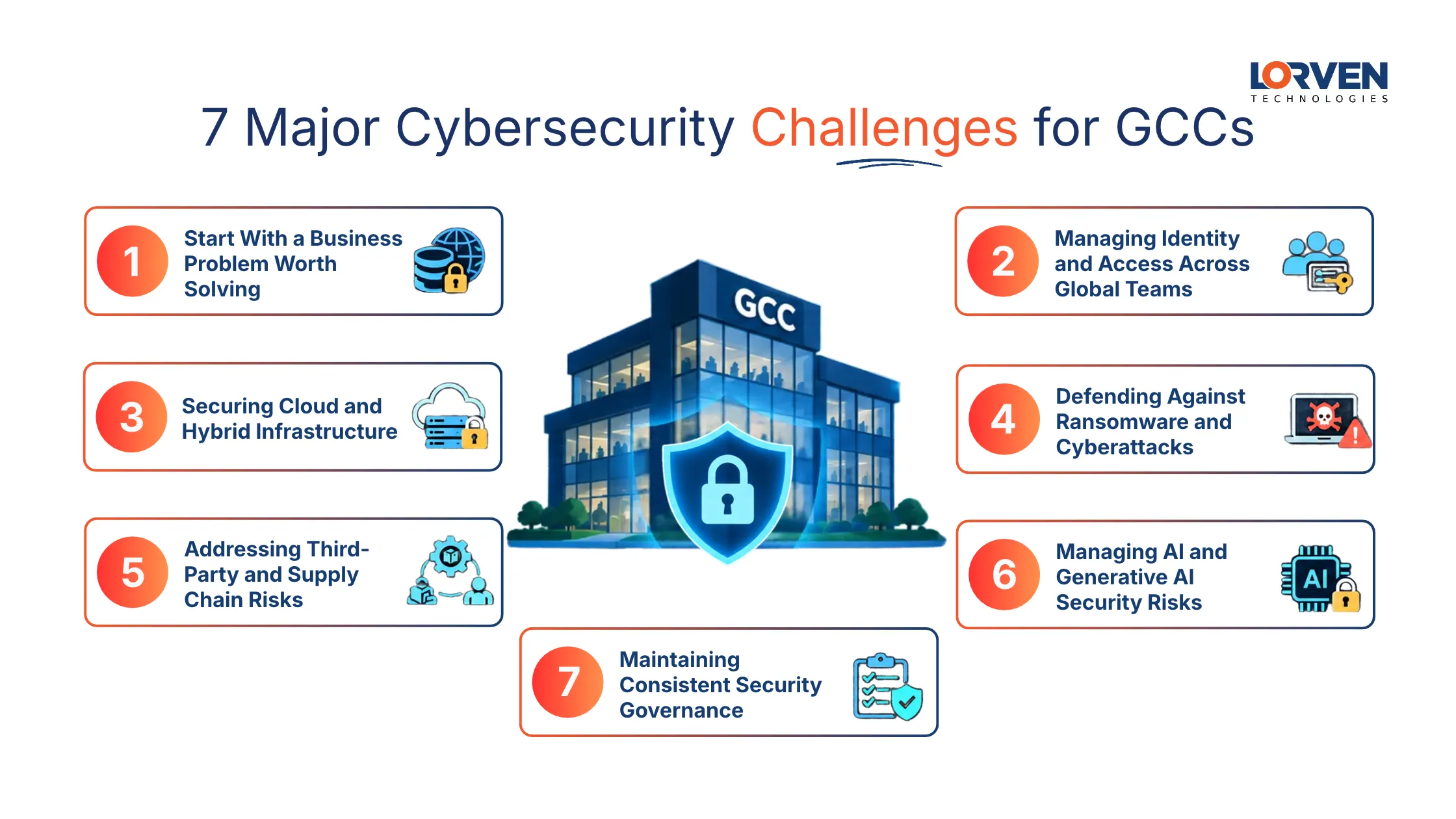
7 Major Cybersecurity Challenges for GCCs
1. Protecting Sensitive Data Across Borders
GCCs frequently access information belonging to customers, employees, and business operations across different regions.
Managing this information creates challenges involving data classification, storage locations, access permissions, and cross-border transfers.
Privacy and security requirements may differ depending on the country, industry, and type of information processed.
How to address it: Establish data classification policies, encrypt sensitive information, restrict unnecessary access, and maintain clear records of data movement. Legal and compliance teams should review applicable transfer requirements.
2. Managing Identity and Access Across Global Teams
Employees, contractors, administrators, and external partners may require access to multiple enterprise systems.
Without consistent identity management, excessive permissions and inactive accounts can become security vulnerabilities.
Privileged access is particularly sensitive because compromised administrator credentials can expose critical infrastructure.
How to address it: Implement multi-factor authentication, role-based access controls, privileged access management, and regular permission reviews.
A zero trust approach can further reduce reliance on network location as proof of trust.
3. Securing Cloud and Hybrid Infrastructure
Cloud platforms enable GCCs to develop applications and expand technology services without maintaining every system on premises.
However, cloud adoption introduces risks related to configuration errors, exposed storage, insecure APIs, and unclear security responsibilities.
Hybrid environments can make these risks harder to identify because workloads operate across different infrastructure platforms.
How to address it: Use continuous configuration assessments, centralized monitoring, encryption, vulnerability management, and automated security checks.
Security teams should clearly distinguish responsibilities belonging to cloud providers from those retained by the enterprise.
4. Defending Against Ransomware and Cyberattacks
Ransomware, credential theft, and phishing can interrupt essential GCC operations.
For centers supporting global applications, even a localized incident may affect teams operating in other time zones.
Attackers may exploit outdated software, compromised credentials, or insufficiently protected endpoints.
How to address it: Maintain endpoint protection, timely patching, network segmentation, tested backups, and incident response procedures.
Regular recovery exercises help organizations evaluate whether critical services can be restored within acceptable business timeframes.
5. Addressing Third-Party and Supply Chain Risks
GCCs often collaborate with software vendors, technology consultants, cloud providers, and managed service partners.
These relationships create additional access points to enterprise systems and information.
Security responsibilities can become unclear when several organizations participate in the same development or operational process.
How to address it: Assess vendor security practices before granting access, define contractual security obligations, and review third-party permissions regularly.
Organizations should also establish procedures for reporting incidents and ending access when engagements conclude.
6. Managing AI and Generative AI Security Risks
As GCCs develop AI-powered applications, they must address security concerns beyond conventional infrastructure protection.
Generative AI systems may expose confidential information through poorly controlled integrations or inappropriate data handling.
Other risks include prompt injection, insecure model connections, unauthorized tool execution, and unreliable AI-generated outputs.
How to address it: Establish AI governance policies, approve model usage, protect sensitive data, and test AI applications against misuse scenarios.
Human approval should remain part of workflows where automated decisions could create significant business consequences.
7. Maintaining Consistent Security Governance
Large GCCs may operate across multiple teams, technology platforms, and business functions.
Different security procedures can create gaps in incident reporting, compliance documentation, and risk ownership.
The challenge increases when local operational priorities differ from global enterprise standards.
How to address it: Define shared security policies, assign accountable owners, and maintain centralized risk reporting.
Regular assessments help leadership understand whether security controls are functioning consistently across the organization.
How GCCs Can Strengthen Their Cybersecurity Posture
Effective GCC cybersecurity depends on a security strategy integrated with enterprise operations.
Organizations should prioritize the following practices:
- Adopt a structured cybersecurity framework. The NIST Cybersecurity Framework 2.0 provides a useful foundation through six functions: Govern, Identify, Protect, Detect, Respond, and Recover.
- Implement zero trust principles. Verify access based on identity, device condition, and authorization requirements rather than automatically trusting internal network connections.
- Improve security visibility. Consolidate relevant security logs and alerts to identify suspicious behavior across connected systems.
- Integrate security into software development. Include code scanning, dependency assessments, secrets management, and security testing within development pipelines.
- Strengthen incident readiness. Establish escalation procedures, test recovery plans, and coordinate responsibilities between GCC and global security teams.
Security effectiveness should be evaluated through measurable outcomes, including vulnerability remediation, incident response, and recovery of readiness.
The Role of AI and Automation in GCC Cybersecurity
AI and automation can help security teams analyze large volumes of activity and prioritize potential threats.
For example, automated detection systems may identify unusual login patterns, suspicious endpoint behavior, or unexpected changes in cloud environments.
Security orchestration can also accelerate repetitive tasks such as collecting incident information and initiating approved response workflows.
However, AI-generated security recommendations should not automatically be treated accurately.
Organizations must validate automated decisions, protect the data used by security tools, and maintain human oversight for consequential actions.
The objective is to help security professionals respond more effectively rather than replace established security judgments.
How Technology Partners Support GCC Cybersecurity
External technology partners can complement internal GCC teams through specialized security engineering, cloud security assessments, application protection, and modernization support.
At Lorven Technologies, our cybersecurity, cloud engineering, and software development capabilities support enterprise organizations working to strengthen their digital environments.
A collaborative approach allows GCCs to retain strategic ownership while accessing complementary technical expertise for defined initiatives.
Conclusion: Building Secure and Resilient GCCs
Addressing cybersecurity challenges for GCCs requires continuous coordination between technology, security, and business leadership.
Strong data governance, identity protection, secure cloud architecture, AI security, and incident readiness help protect enterprise operations while enabling innovation.
Lorven Technologies supports digital transformation through cybersecurity and enterprise technology solutions designed to evolve business requirements.
Explore our cybersecurity capabilities to strengthen your enterprise’s digital resilience.