Artificial intelligence is becoming an integral part of how modern businesses solve problems. Whether it is accelerating document reviews, identifying unusual transactions, or helping employees find information faster, AI is creating opportunities to redesign everyday operations.
However, a promising AI idea does not automatically translate into a useful business application. Organizations must consider where AI fits, what information it needs, how the application will operate, and whether its results can be trusted.
Understanding how to develop AI software means looking beyond algorithms and focusing on the complete journey from business discovery to production deployment. This guide explores six essential stages of building practical, secure, and scalable AI solutions.
What Is AI Software Development?
AI software development involves creating applications that use intelligent models to interpret information, identify patterns, make predictions, or generate responses.
Traditional software relies largely on instructions explicitly written by developers. AI applications introduce capabilities learned from data or provided by pretrained models. This allows them to handle tasks that are difficult to describe through fixed programming rules.
Common Types of AI Software
Businesses can apply AI in several ways:
- Predictive systems: Estimate future demand, detect anomalies, or anticipate equipment failures.
- Generative AI applications: Produce summaries, answer questions, and assist with knowledge-intensive activities.
- Intelligent automation: Extract information from documents and coordinate repetitive business processes.
- Computer vision and language processing: Interpret visual content, classify text, and understand customer requests.
Consider an insurance company receiving thousands of claim documents. An AI application could identify document types, extract relevant information, and route cases for appropriate review.
The value comes not simply from recognizing information, but from integrating that capability into an existing business workflow.
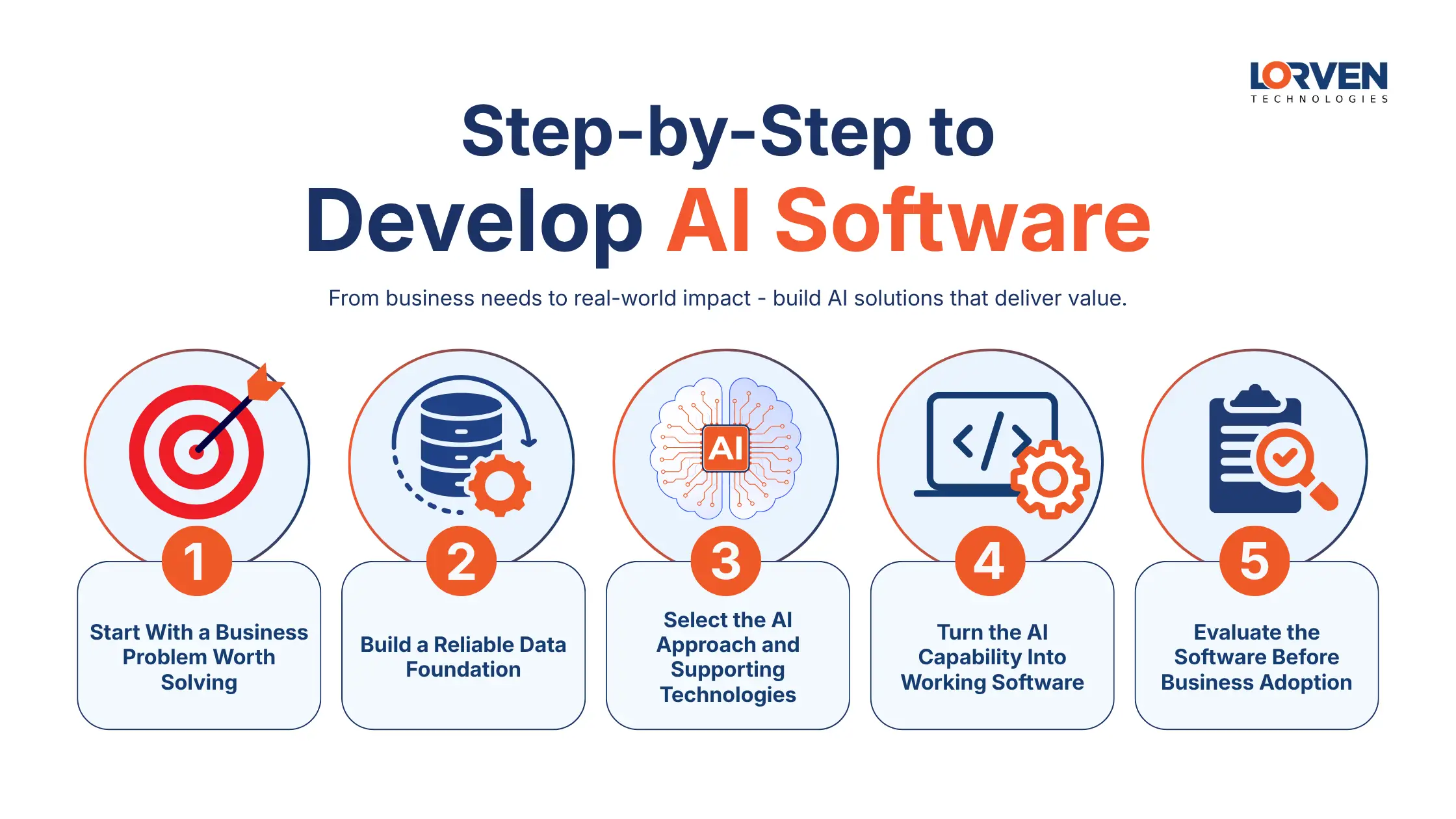
Step 1: Start With a Business Problem Worth Solving
The first decision in the AI development process should not be which model to use. It should be which business problem deserves attention.
A useful starting point is to examine activities where employees spend significant time gathering information, checking inconsistencies, or repeating similar decisions.
Business and engineering teams should agree on:
- The problem and its effect on operations.
- The people who will use the solution.
- The information and systems involved.
- The expected improvement and acceptable risks.
- The indicators that will demonstrate success.
For example, a finance department might aim to reduce invoice review time while maintaining approval accuracy.
This gives developers a concrete outcome to design around and prevents AI adoption from becoming an experiment without a defined purpose.
Step 2: Build a Reliable Data Foundation
An AI system can only work effectively with information suitable for its intended task.
For some projects, this means preparing historical records for model training. For others, particularly generative AI applications, it means making approved business knowledge accessible to an existing model.
Data preparation may involve removing duplicate records, correcting inconsistencies, validating formats, labeling examples, and separating sensitive information.
Organizations should also answer important questions: Who owns the data? Who can access it? How frequently does it change? Can its origin and accuracy be verified?
These considerations form the basis of effective data governance.
For instance, an AI assistant using outdated product policies may provide incorrect guidance even when its underlying language model performs well.
Reliable AI begins with information that is relevant, current, and properly governed.
These categories are interconnected. Generative models can power AI agents, while agentic systems may coordinate multiple agents, tools, and models.
The most suitable architecture depends on the business process rather than terminology.
Step 3: Select the AI Approach and Supporting Technologies
Not every AI application requires a model built from the ground up.
The right technical approach depends on the problem, available data, expected accuracy, operating environment, and long-term costs.
AI Development Tools and Technologies
| Technology | Where It Fits |
|---|---|
| PyTorch and TensorFlow | Developing and training machine learning models |
| Large Language Models | Text generation, summarization, and conversational interfaces |
| Retrieval-Augmented Generation (RAG) | Connecting language models with relevant business knowledge |
| AWS, Azure, and Google Cloud | AI infrastructure, managed services, and application hosting |
| Python and FastAPI | Backend services, APIs, and AI application integration |
Organizations generally have three broad options: use an existing model, adapt a pretrained model, or develop a specialized model.
An existing model may be sufficient for document summarization. A retrieval-based architecture may be more suitable for answering questions using internal policies. Specialized predictive models may be appropriate when businesses possess relevant historical datasets.
Model selection should also account for latency, privacy, infrastructure requirements, and the cost of processing each request.
The simplest architecture that meets the business requirement is often the most maintainable.
Step 4: Turn the AI Capability into Working Software
A functioning model is only one component of a complete AI application.
Users still need an interface; business systems must exchange information, and operations teams need ways to manage access, monitor activity, and resolve failures.
During AI application development, engineers typically work on application interfaces, backend services, model connections, databases, and integrations with existing enterprise platforms.
An early prototype should focus on one meaningful workflow rather than attempting to automate an entire department.
For example, a customer service AI application might initially summarize support tickets before expanding knowledge of retrieval or suggested responses.
Developers should also define what happens when the model cannot provide a dependable result. Escalation paths, human approval, and clear error handling help prevent uncertain outputs from becoming operational mistakes.
This incremental approach allows businesses to evaluate usability and technical performance before broader deployment.
Step 5: Evaluate the Software Before Business Adoption
AI testing goes beyond checking whether buttons, databases, and APIs function correctly.
The application must also demonstrate that its outputs are useful, sufficiently accurate, and appropriate for real business situations.
Testing should include representative scenarios, incomplete information, unusual inputs, and situations where the system should decline to provide an answer.
For generative AI, evaluation may examine factual correctness, response relevance, unsupported claims, and vulnerability to malicious instructions.
For predictive applications, teams may assess precision, recall, error rates, and performance across different data groups.
Security reviews should cover sensitive data handling, authentication, integrations, and permissions.
Most importantly, business users should participate in acceptance testing.
A technically impressive application may still fail if its recommendations are difficult to understand or do not match actual workflows.
Step 6: Deploy, Monitor, and Continuously Improve
Production deployment marks the beginning of an AI application’s operational life, not the end of development.
The deployment approach may involve cloud infrastructure, private environments, or a hybrid architecture depending on security and performance requirements.
Once operational, engineering teams need visibility into response times, system availability, model behavior, and usage costs.
They should also track whether the application continues to achieve its original business objectives.
A model that performs well during initial testing may become less useful as customer behavior, business rules, or underlying data changes.
MLOps practices help manage model versions, deployments, evaluations, and updates. Rollback procedures provide a controlled way to respond when new changes introduce problems.
Ongoing monitoring allows organizations to improve AI capabilities without sacrificing operational stability.
Common Challenges in AI Software Development
Enterprise AI initiatives often encounter difficulties that extend beyond model development.
Information may be distributed across disconnected systems. Older applications may lack modern interfaces. Sensitive data can introduce privacy restrictions, while unpredictable model responses create additional review requirements.
Costs also deserve attention. Model inference, cloud infrastructure, data pipelines, monitoring, and ongoing maintenance all contribute to the total investment.
Another challenge is coordinating the different disciplines involved, including software engineering, data management, cybersecurity, and business operations.
Organizations can reduce these risks by limiting the initial project scope, validating assumptions early, establishing clear ownership, and introducing governance before expanding adoption.
Best Practices for Building Scalable AI Software
Successful custom AI software development requires technical discipline alongside business clarity.
- Define business outcomes before making architecture decisions.
- Evaluate whether AI is necessary for the proposed task.
- Establish data quality and access standards.
- Build a focused proof of concept before scaling.
- Design integrations, security, and observability from the beginning.
- Keep human reviewers involved when decisions carry significant consequences.
- Measure long-term value through business KPIs, not model performance alone.
These practices help enterprises create AI applications that remain practical as requirements, workloads, and technologies evolve.
Conclusion: Turn AI Ideas into Business Solutions
Developing enterprise AI software is a coordinated engineering effort involving business strategy, data readiness, model selection, application architecture, testing, and continuous improvement.
At Lorven Technologies, our focus on AI, custom software development, cloud engineering, and digital transformation supports organizations pursuing intelligent, future-ready technology solutions.
Planning an AI-powered application for your business? Connect with Lorven Technologies to explore an engineering approach aligned with your enterprise objectives.